
Summary
Background
Extracted from: T.Loads Abbreviated Systems Architecture; Bob Hamber 2001
The Tactical Logistics Distribution System (T.LoaDS or TLoaDS) is a powerful and flexible simulation application for assessing current or future tactical or sea-based distribution systems. In its current state of development, it is an analytical model for assessing the pros and cons of new doctrine, distribution techniques, organizational structures, and equipment concepts. It can also be used to find out how to best use available resources to sustain a military force in a wide variety of scenarios. The "System" in TLoaDS refers to its modular architecture and that it is more that just a simulation. It is a suite of analytical study tools.
Model Purpose
TLoaDS provides a way to qualitatively assess the performance of tactical distribution systems in sustaining the forces ashore from a sea base, port of debarkation, beach support area, or Army or Air Force theater base.
Original analytical uses of TLoaDS:
- Explore emerging concepts such as Sea-Based Logistics, enhanced combat trains, just in time distribution, and many others
- Assess under what conditions different distribution networks, reorder policies, stock objectives, convoy plans, and many other tactics and techniques are appropriate
- Evaluate alternative concepts for future seabasing ships, cargo handling equipment, transporters, and shipping containers
- Plan the logistic resources required to reliably sustain a given force for a given time in a given threat and environmental scenario
- Determine the odds a given force can be sustained for a given time
Description
At its core, TLoaDS is a supply chain throughput model. The core module is a stochastic "discrete event" simulation, as private industry now employs for critical supply chain problems. It uses the latest commercial-off-the-shelf (COTS) supply chain modeling environment, with custom TLoaDS code components. When it runs, the simulation engine keeps track of how all the individual commodities, orders, shipments, material handlers, and transporters interact with each other and their current environment according to the current process rules.
As TLoaDS runs, it generates a wide variety of outputs that shed far more light into what is going on in the system, than spreadsheet, knowledge base, neural network, or linear programming models do. Numerous non-core TLoaDS modules greatly aid the analyst in managing and processing the vast amount of input and output data involved in a study. These include modules to:
- manage the different simulation levels involved in a study;
- help prepare and advise the analyst in setting up the model inputs;
- understand the detailed and overall performance of the distribution system, using an online documentation system
Strategic Assessment
The following provides links to articles within this document that address strategic assessment issues related to this case study:
- Tactical Analysis of System Loading
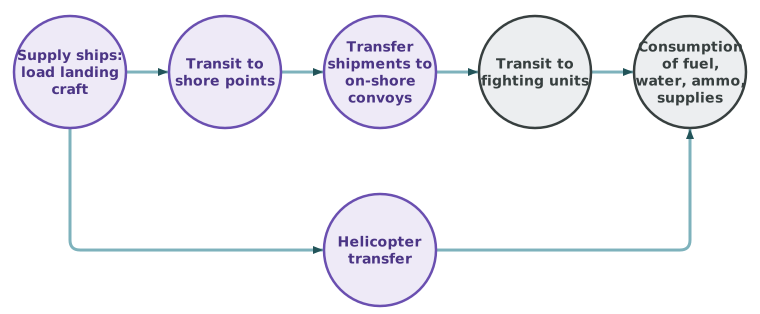
This model was designed to assess combinations of air, sea and land transporters for re-supply of marine units in combat. Movement of fuel, water, ammo, and other supplies was modeled.
Details
Sponsorship
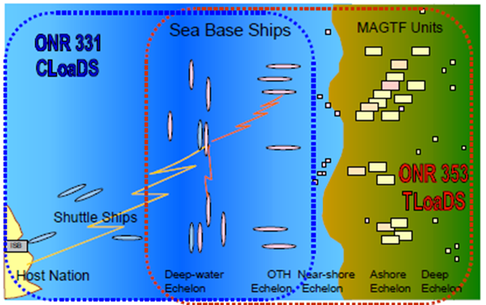
TLoaDS development started in 1997 under the sponsorship of Marine Corps Systems Command's Amphibious Warfare Technology Directorate. The model was originally intended to be just an in-house logistics technology assessment tool. This sponsorship transitioned to the Office of Naval Research (ONR), Code 353 in 1999. In 1998, ONR, Code 331, sponsored an extension to TLoaDS to simulate processes unique to the intra- and intership operations involved in shipboard cargo handling operations and underway replenishment. This portion of the logistic system gets into the operational level of logistics. Versions of TLoaDS with this functionality, are referred to as C.LoaDS or CLoaDS (pronounced and understood as "sea-loads"). Unless otherwise specified, this paper applies equally to CLoaDS as to TLoaDS including all of the above text.
Relationship between TLoaDS, CLoaDS, X.LoaDS and A-LoaDS
TLoaDS and CLoaDS are application names defined in context of both the current sponsors and initial uses. TLoaDS is designed to simulate the sustainment and movement of marine air ground task forces (MAGTFs) ashore from ships at sea, as if those ships never run out of supplies. CLoaDS is designed to simulate the sustainment of those ships at sea. This includes the shuttle ships resupplying the station ships, and the station ships resupplying the ships that resupply the MAGTF. The figure to the right shows this simplistic application relationship.
Paper
Tactical Logistics and Distribution Systems (TLoaDS) Simulation; David J. Parsons, L. C. Krause, Simulation Dynamics. 1999 Winter Simulation Conference.