
Simulation consulting
Simulation modeling services for lines, plants and supply chains
We build a model of your operation and use it to answer one question: what would happen if you changed it? Buffers, line speeds, staffing, capacity, inventory. You see the result before you spend the money.
What we model
Four places a model pays for itself
We have built simulation models for manufacturers and shippers for more than 35 years. Most of the work falls into these areas.
Production lines
Find the real bottleneck, even when it moves with the product mix. Test capital, scheduling and staffing changes first.
Production line simulationPackaging lines
High-speed filling and packing: buffer and conveyor sizes, line speeds, downtime and changeovers.
Packaging line simulationSupply chains
Run length, safety stock, deployment and ordering policies, tested on months of operation in minutes.
Supply chain simulationLogistics and warehouses
Vehicle networks, automated warehouses and resupply systems, sized and scheduled before they are built.
Logistics casesTool agnostic
We pick the tool after we understand the question
We don't sell software, so we have no reason to push one package. A rate-based model suits a high-speed packaging line. A detailed discrete event model with 3D animation suits a plant team that needs to see the layout move. A supply chain question may need a custom engine that runs a year of history in minutes.
We have deep roots in two tools and we work in whatever your team already runs:
- ExtendSim: 35+ years of projects, and the bulk flow (rate) and database libraries we built for it.
- Siemens Plant Simulation: 15+ years and more than 50 models of lines, plants, warehouses and supply chains.
- Custom code: when a model outgrows its tool, we rebuild it in .NET, C# or F# so it runs fast and planners can use it.
From the field
Sometimes the model is done before it runs
A client planned a new operation and asked us to model it. As we worked through how the model would handle a machine running out of supplies or breaking down, it became clear the system could not be run as designed. The operation leaders called and cancelled all of their long-lead equipment orders.
A simulation has to march forward through time and deal with every realistic event, so the specification cannot be fudged. Building the model forces the right questions.
How a project runs
From question to answer you can defend
1. Name the decision
What are you about to spend, change or commit to? The model is scoped to that decision, not to everything in the building.
2. Build from your data
Rates, failures, repair times, schedules, demand and forecasts come from your own records. The model is checked against how the operation really ran.
3. Run the experiments
We vary the factors that matter, such as buffer size, run length or staffing, and show where the returns start to flatten.
4. Keep it working
Many clients keep using the model. Any model we make can become an app your planners run themselves, with only a little more effort.
Case studies
Models that answered a real question
A food plant, a chemical packager and a vehicle distribution network. Each one had money riding on the answer.
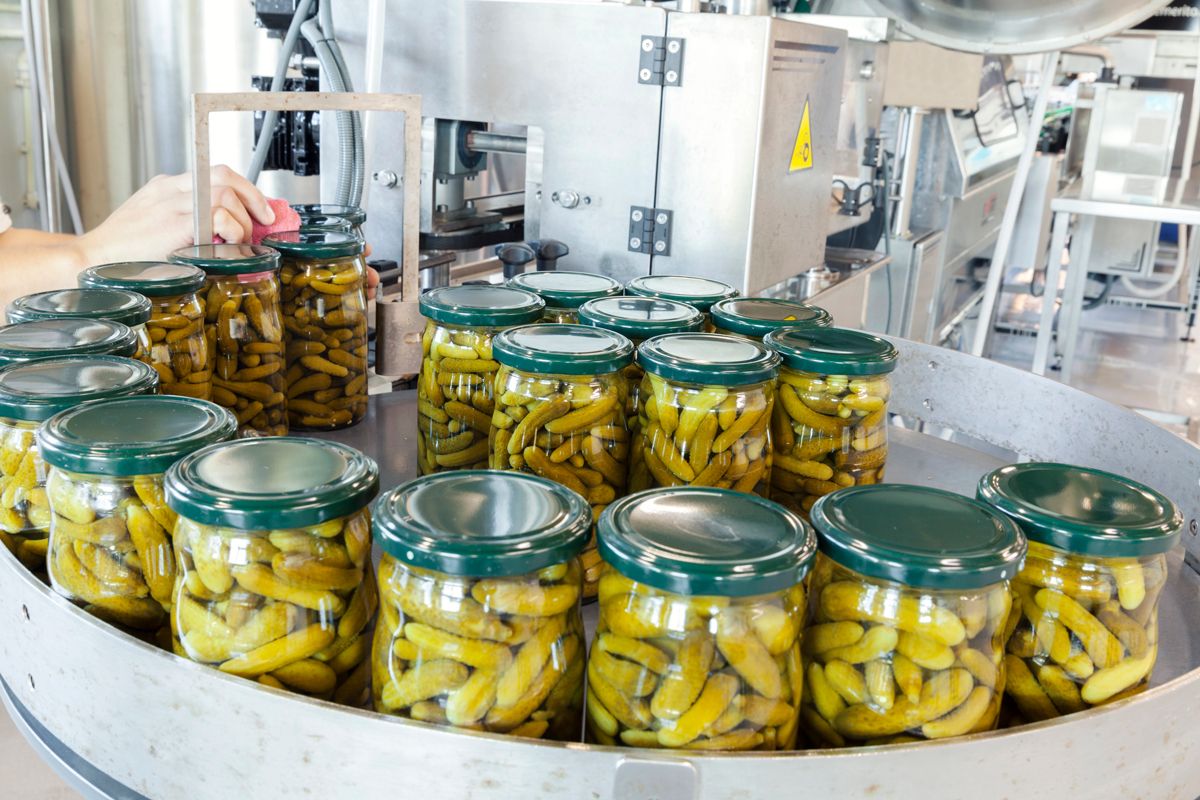
Olive plant capacity: 15% more throughput
Finding the real bottlenecks in an olive plant, and 15% more throughput from scheduling.
15% throughput improvement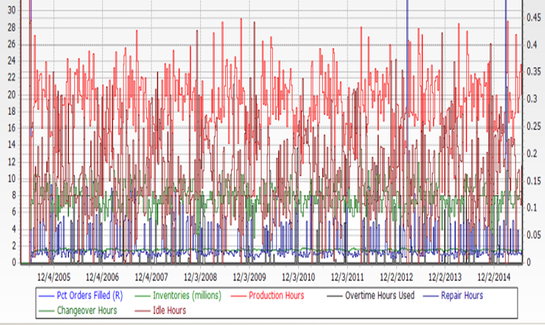
Chemical bagging lines: capacity vs. overtime
Weighing new bagging lines against overtime, and finding low-capital room to grow.
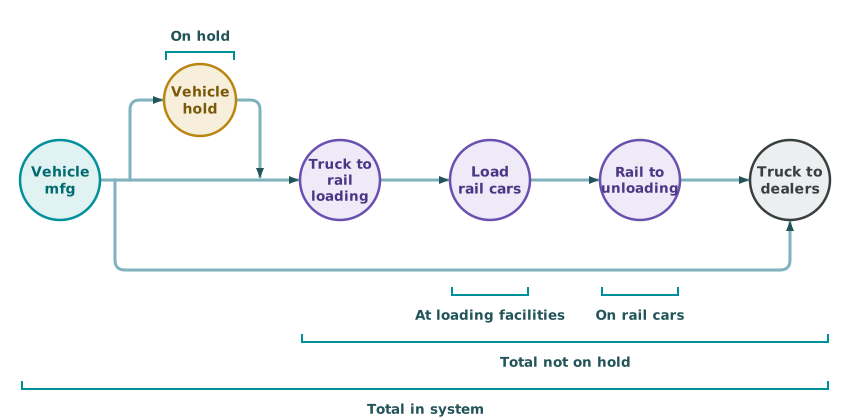
VINLogic: $21.7M saved in vehicle distribution
Forecasting a 2.5M-vehicle rail network: $21.7M saved and transit time cut 19%.
$21.7M inventory carrying costs savedA method we started
Rate-based models for high-speed lines
Andy Siprelle created bulk flow simulation in 1990 to model lines that move product as a flow rather than one part at a time. It later became discrete rate simulation. We still use it on packaging, food and bulk-handling lines where a conventional model would be slow to run.
How discrete rate simulation worksBeyond the model
When the model should become an app
A model that answers one question well often gets asked the next one. We wrap models in apps that planners, analysts and finance teams run on their own, in the language of their job. One started as a six-hour model and became a 20-minute tool a CFO used for the annual budget.
Custom applicationsTell us your problem
What would happen if you changed it?
Describe the decision in front of you. We'll tell you whether a model can answer it, and what it would take.
- A straight answer on whether simulation is the right tool
- Which tool fits, even if it isn't one we use every day
- A rough scope and timeline, before any commitment