
Supply chain simulation consulting
Supply chain simulation for inventory, ordering and run-length decisions
Every supply chain runs on dozens of policies: how long to run, how much to hold, where to hold it, when to ship. Each one makes sense to the person who owns it. A model shows what they do together, and lets you test a new one on months of operation in minutes.
Why simulate
Local rules, system-wide results
Run lengths are set by production schedulers. Order minimums are set by sales. Shipping rules are set by logistics. Each person tends to optimize their own piece, and that often works against the whole.
These are the kinds of things companies find when they look closely:
- Safety stock on both sides of one pipeline. Supplier and customer each insure against the same stock-out, and the customer has no idea what the supplier's insurance costs.
- Old information. An order sits for six days because the supplier plans on Tuesday and the order arrived Wednesday. Repeat that up the chain and the first supplier works from information nearly three weeks old.
- Variability the company created. Safety stock that was meant to protect against demand swings was really protecting against lumpy supply from the plant, caused by a rule to ship only full truckloads.
Run length
Why EOQ can mislead
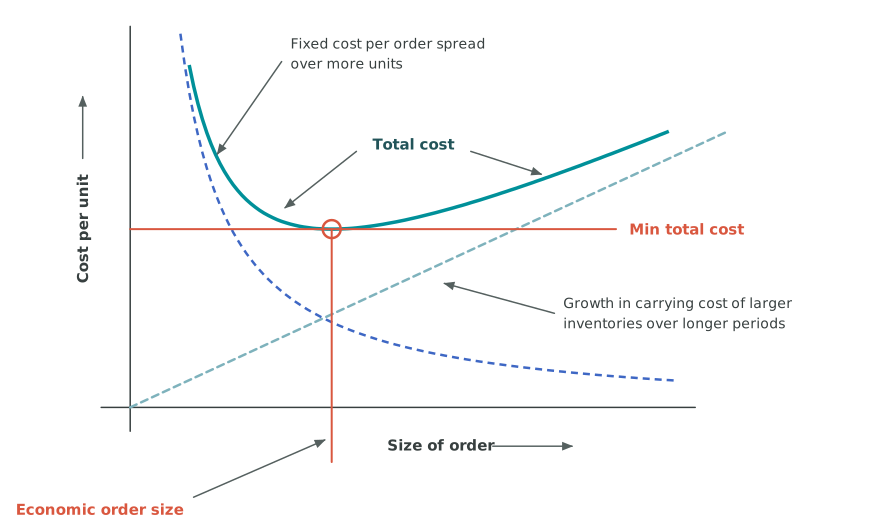
The textbook economic order quantity balances changeover cost against carrying cost. It leaves out forecast error and misallocation. Long runs of a base product must be split among the finished items made from it, based on a forecast. When one item runs out early, the next run starts early too, and inventory goes up.
Production run lengthWhat we model
The supply chain questions we test
Each topic links to a longer write-up on our self-guided tour, with charts from real studies.
Structure
Who gets what from where. Regional DCs or direct shipment, plants that make everything or plants that specialize. Optimization proposes networks; simulation shows how they behave over time.
Supply chain structureSafety stock
The textbook formula is a starting point. Cycle stock, delivery delays, fixed reorder cycles and intermittent demand all change the answer. In our experience a 50/50 mix of fixed and variable safety stock beats either one alone.
Safety stock designInventory deployment
Hold cycle stock at the plant, or push it to distribution centers? Upstream pools risk. Downstream protects safety stock but risks misallocation and DC-to-DC redeployment.
Inventory deploymentPostponement
Moving labeling, packaging or assembly closer to the customer. Which operations, how far downstream, and for which products.
PostponementDemand over capacity
Overtime, shifting production to another plant, prebuilding or shaping demand. Simulation shows the tradeoff between more capacity and less overtime.
Production capacityFlexible ordering
Orders with long lead times that can be revised within agreed limits. Less safety stock for the buyer, more predictable demand for the supplier.
Flexible ordering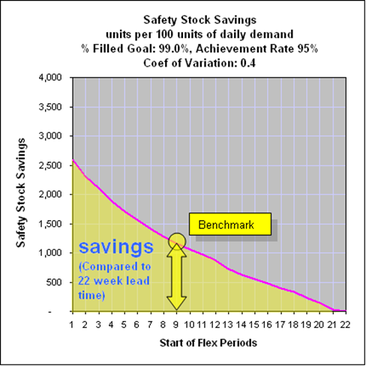
A study we ran
How much can flexible ordering save?
We ran an independent simulation study of flexible ordering, using a test case with a 22-week lead time. The buyer could revise order quantities within set windows and percentages before delivery.
A benchmark contract, with four-week flex periods of 10% starting in week 9, captured about 77% of the maximum possible safety stock savings. Savings were very sensitive to flexibility in the first flex period and hardly sensitive at all to the third.
A buyer who can simulate alternative contracts, and knows the supplier's price for each, can negotiate from facts.
See the full studyCase: inventory deployment
Plant or distribution center?
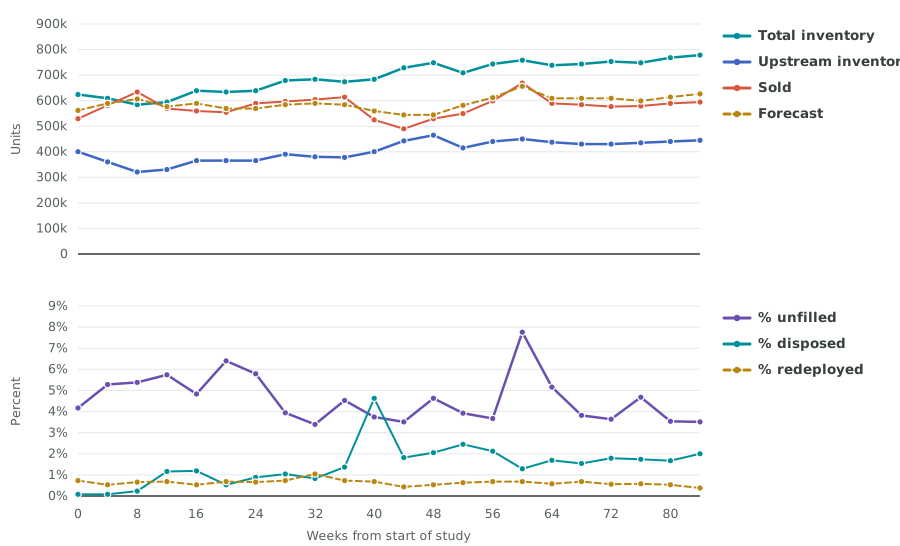
A U.S. consumer goods maker produced bulk material on cycles of 7, 14, 28 or as many as 91 days, which left large cycle stocks of finished goods. We modeled holding that stock at the plants against pushing it to distribution centers, and measured total inventory, order fill rate, redeployment and disposal of aged product, item by item.
The study is written up in "Benefits of Using a Supply Chain Simulation Tool to Study Inventory Allocation," Siprelle, Parsons and Clark, Winter Simulation Conference 2003.
Read the caseCase: VINLogic
A model that became a tool
A vehicle distribution model first built in our Supply Chain Builder library took six hours to run. We rebuilt it in .NET so it ran in 20 minutes, with screens analysts and a CFO could use. It stayed in use for more than 10 years and is credited with more than $1 billion in annual savings.
Read the VINLogic caseCase studies
Supply chain models we can show you
Deployment, postponement and life-cycle capacity.
Where to hold cycle stock: plants or DCs
Plants or distribution centers? Testing where cycle stock should sit, item by item.
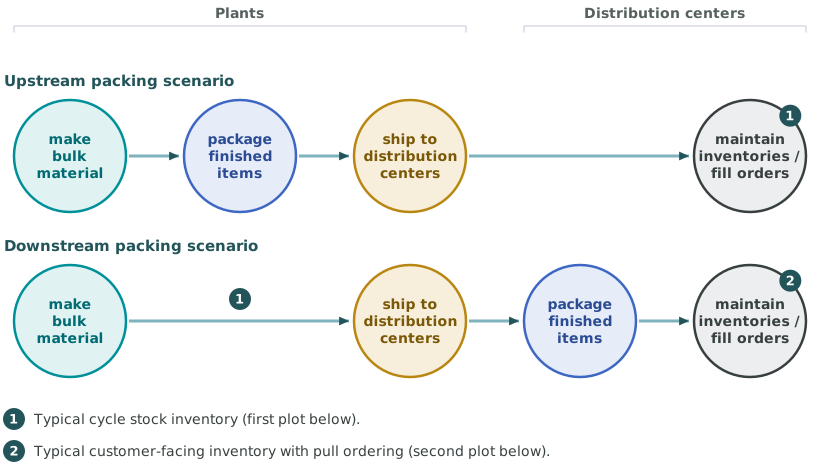
Packing at the DC: inventory vs. bulk stock
Should packaging move to the distribution centers? The answer, product by product.
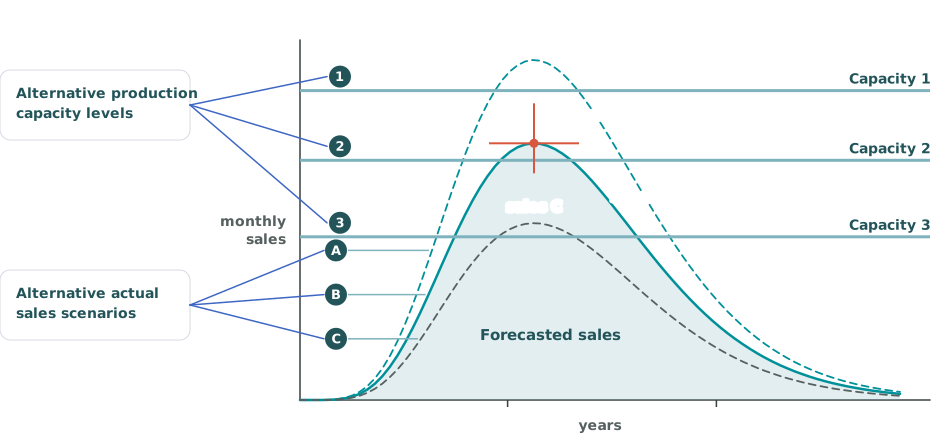
Electronics life cycle: capacity vs. peak demand
How much capacity to commit before demand is known, with overseas lead times.
Tell us your problem
What would happen if you changed it?
Describe the decision in front of you. We'll tell you whether a model can answer it, and what it would take.
- A straight answer on whether simulation is the right tool
- Which tool fits, even if it isn't one we use every day
- A rough scope and timeline, before any commitment