
Summary
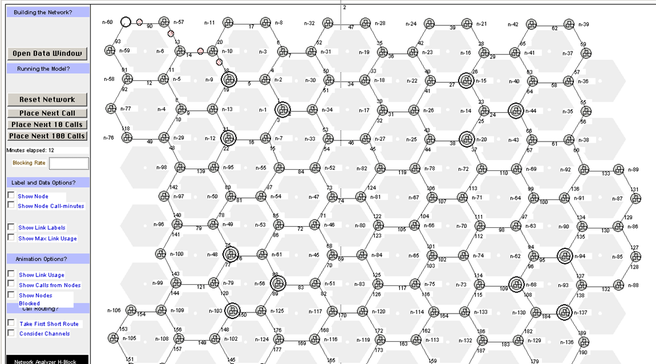
Simulation Dynamics has developed a network simulation used to dynamically model calls made from and through a network of nodes. The system consists of graphical building blocks and a model template. This system has been applied in a model used to study the feasibility of a business venture involving a new kind of cellular phone system. The model, pictured below, simulates the transmission of calls from any wireless "source" node through a network of other nodes, and to designated exit points, or POPs (Points of Presence). A POP is indicated in the model layout as a double circle. In this system, any node can place a call. The destination for a call is the nearest POP. POPs are connected to the wired network, which is outside this model's scope. To reach a POP, a call must be routed through other nodes via links from node to node. The purpose of the model is to understand the relationship among call patterns, network layout, channels and blocking rate.
Key Model Issues
Using the library of network component blocks which comes with the system, the user builds a network simulation by pulling graphical node blocks onto the screen, and connecting them together. In the model, any node can be connected to up to 3 other nodes. Any node can be defined as a POP. Following graphical model layout, a central analyzer block surveys blocks on the model, and builds a database of the relationships among nodes and links. The connections, or links drawn by the user, can be defined in the database to carry a limited number of calls. The database houses additional tables for input and output. For example, a Call Patterns table is provided for defining various patterns of call intervals and durations. Each node can be assigned a different call pattern. Once built, the entire database can be exported to another package, such as MS Excel or Access — or explored directly in the browser using the Cloud DB Viewer.
When the model is run, performance information is indicated on the graphical layout using text and colors. For example, a link which becomes increasingly busy will change in color from light blue to red. When a link becomes red, calls must be re-routed. In the database, a table stores run statistics such as each node's throughput in call-minutes, and each link's maximum channel utilization. The model also computes the overall blocking rate, defined as the number of blocked calls divided by the number of attempted calls.
During the model run, an algorithm is used to determine call routing. Whenever there is a change in the availability of a link, the minimum number of links from each node to a POP is calculated and stored in the database. When a call is placed from a node, the route to a POP is found by looking for a connected node which is one link closer to a POP. The route is then traced "downhill" from one node to the next until a POP is reached.
Options for the routing algorithm may be specified. In the "Take First Short Route" algorithm, the first available route is selected, regardless of the channels available. In the "Consider Channels" approach, if there are two equal routes, the one where the next link has the most channels available is taken. The first approach will fill up the channels of one route before switching to an alternative route of equal distance. The second approach spreads traffic among equal routes.
The network simulation architecture is founded on a system which is continuously developed to suit customer needs. The architecture is designed in a general fashion to support a wide class of problems. The system is supplied by Simulation Dynamics inclusive of training and the modeling of a selected network process. Models are easily transferred between Windows and Macintosh computers.
Strategic Assessment
The following provides links to articles within this document that address strategic assessment issues related to this case study:
- Network capacity
This model was used to dynamically simulate calls made from and through a network of transmission nodes. The system consists of graphical building blocks and a model template.