
Insights
The full-truckload rule that quietly created its own safety stock
A company held safety stock to protect against swings in customer demand. When it looked closely, the stock was mostly protecting against swings in supply, and its own shipping rule was causing them.
What the company found
This one comes from our 2003 essay on why supply chain management matters. A company carried safety stock at its customer-facing inventories and assumed, as most companies do, that the stock was there to cover forecast error. It was not. It was covering variability in supply from the plant, and that variability came from a shipping policy that required full truckloads.
The company had created the variability it was insuring against. Nobody had decided to hold that stock. It grew out of two sensible rules, each owned by a different group: ship only full trucks, and hold enough safety stock to hit the service goal.
We wrote a paper on full-truckload policy. The pattern is worth understanding because it is common, and because the usual safety stock formula cannot see it.
What the standard formula assumes
Under idealized conditions, safety stock is a function of the service goal, the resupply time and demand variability:
safety stock = demand × standard deviation × k × √resupply time
Here k comes from the service goal: 1.645 for 95% of orders filled, 2.054 for 98%, and 2.326 for 99%. Raise the service goal, lengthen the lead time or add demand variability, and safety stock goes up.
When the assumptions hold, the formula works. With daily demand forecast at 1,000 units, a 7-day lead time and a 98% case fill goal, a safety stock of 2,500 units lets inventory approach zero several times without running out, which is a sign that it is sized properly.
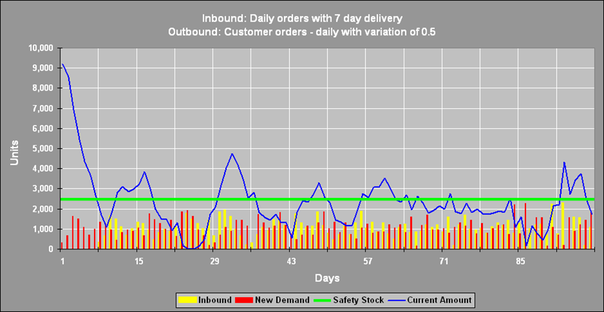
The catch is in the word "idealized." The formula assumes orders go out every period to top the inventory back up, and that supply arrives on time. A full-truckload rule breaks both assumptions.
How a truckload rule makes supply lumpy
Under a full-truckload rule, a shipment does not leave when the customer-facing inventory needs it. It leaves when there is enough product to fill a truck. That changes the supply side in three ways, and each one is a known complication to the basic formula.
1. Orders arrive on a cycle, not every day
When replenishment waits for a full load, the inventory is effectively on a reorder cycle. The effect of a fixed order cycle is to add the days in the cycle to the resupply time. Each shipment has to cover forecast error for the whole time until the next one arrives.
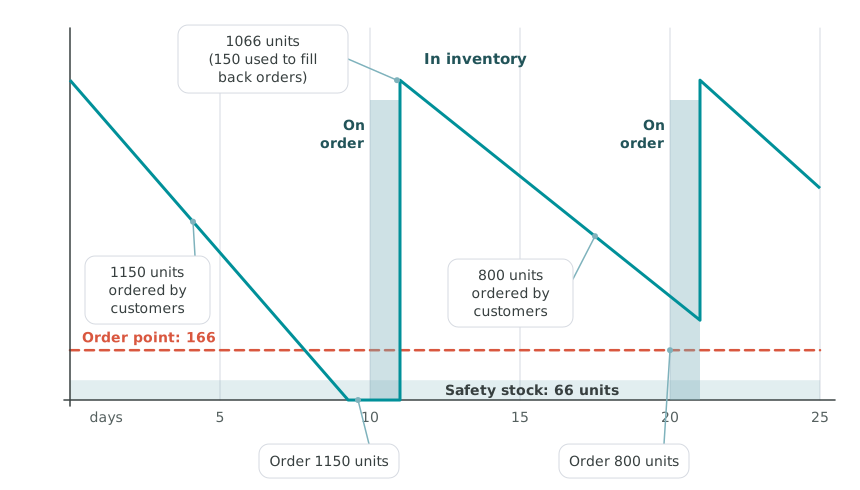
In this example, orders go out every 10 days against a forecast of 100 units a day. The 66-unit safety stock assumed daily orders covering one day of forecast error. In the first cycle demand was 1,150 units, and stock ran out partway through day 9.
2. Shipment timing varies
Waiting for a truck to fill means the departure time depends on how fast product accumulates at the plant. Delivery time becomes variable. For safety stock, what matters is not how late any one shipment is but how many shipments can be late at the same time, and that depends on the ratio of the delivery time's standard deviation to the order cycle. A delay standard deviation of 4 days with orders every 2 days gives a cycle standard deviation of 2. A standard deviation of 14 days with a 7-day cycle gives the same result.
3. Stock arrives in big lots
A full truck is a lot size, and lot sizes create cycle stock. That part of the story cuts the other way: the formula can overstate safety stock when deliveries come in large lots.
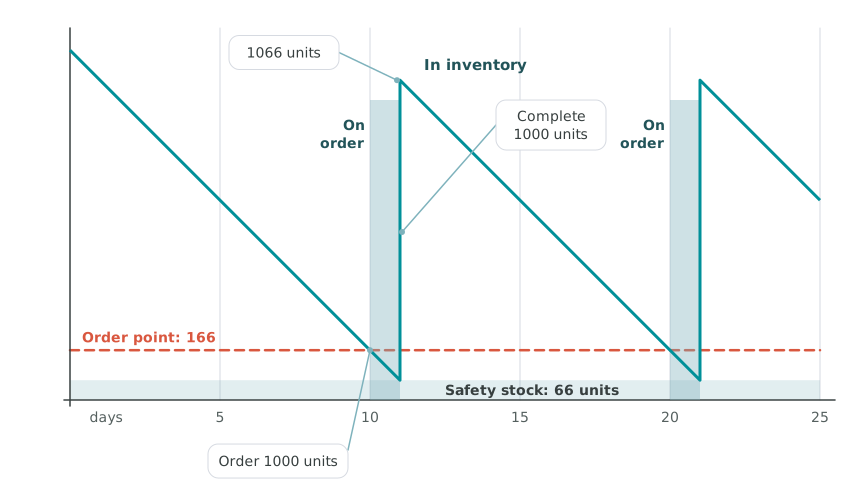
With 1,000-unit lots and demand of 100 a day, stock can only run out on the last day or two of each cycle. A safety stock built for a 99% goal on every day is oversized. A rough recalculation at 90% fits better, since only one day in ten is at risk.
Why nobody sees it
These effects pull in different directions. Lot size can mean too much safety stock. The reorder cycle and uneven timing can mean too little. The net result depends on the demand pattern, the truck size, the production schedule and how the rules interact, which is exactly the kind of answer a formula cannot give.
Meanwhile, each rule looks reasonable to the group that owns it. Transportation sees full trucks and low freight cost per unit. Inventory planning sees a service goal being met. The cost of the safety stock that the shipping rule created shows up in nobody's report. The same essay describes a supplier and a customer each holding safety stock on either side of one pipeline, insuring against the same stock-out, with the customer unaware of what the supplier's insurance costs.
How to test it
The question to ask is "what would happen if we changed the shipping rule?" A supply chain model can run the network as it is, then run it again with a different rule, and compare inventory, fill rate and freight cost side by side:
- Keep full trucks, but top them off from stock held upstream. Upstream stock pools demand variability and can fill out partial truckloads.
- Allow partial loads for certain products or lanes.
- Resize safety stock for the real reorder cycle and delivery variability, instead of the idealized one.
We have seen the adjusted formula work well once the real pattern is in it. In one downstream packaging study, the baseline calculation, modified for fixed weekly packaging schedules, accurately predicted the safety stock the model needed at customer-facing inventories. Read the downstream packaging case. In an inventory deployment study, long production cycles, intermittent demand and DC-to-DC redeployment required substantial empirical adjustments on top of the baseline.
Either way, the starting point is to find out what your safety stock is actually protecting against. That is what supply chain simulation is for.
Tell us your problem
What is your safety stock really protecting?
Tell us how your network ships and replenishes. We'll tell you what a model could show about where the stock comes from.
- A straight answer on whether simulation is the right tool
- Which tool fits, even if it isn't one we use every day
- A rough scope and timeline, before any commitment