
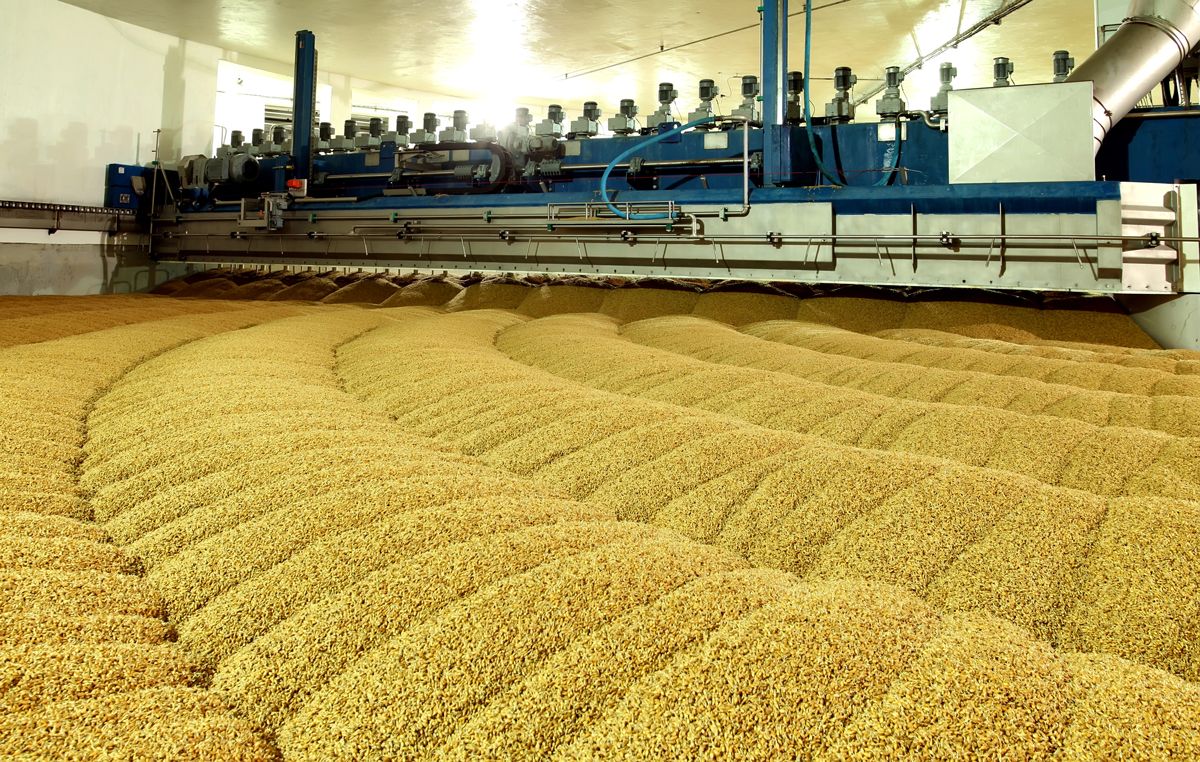
Jim Breslin of Process Partners holds patented technology that shelf-stabilizes partially cooked corn grit. A cereal maker can set the grit aside and pick up the flaking later, even at a different location. Picking the grit back up is called reconstitution. The idea could help cereal makers find production capacity without building it. Before any customer would invest, though, someone had to answer two questions: how big should the system be, and what is it worth in a particular plant?
The plant
In a flaked cereal line, the cooking end and the downstream end are tied together. Reconstitution breaks that tie in three steps:
- Off-ramp. Excess cooked grit is stabilized so it can be stored.
- Store. Stabilized grit waits in in-process storage.
- On-ramp. When there is room downstream, stored grit is reconstituted and fed back into production.
Every part of that has a cost and a size, and the right answer depends on how the plant actually runs.
How we modeled it
SDI and Process Partners built a discrete rate simulation of the process and wrapped it in a web application. We designed the app around the plant's own terms rather than simulation terms. Its inputs cover cooking, grit stabilization for off-ramping, in-process grit storage, and reconstitution and on-ramping. Its results show what each configuration does to inventory and to production capacity.
The model runs on real production data. It uses a year of weigh belt history along with process parameters for cooking and stabilization, warehouse capacity and storage requirements, and investment cost parameters for sizing the equipment.
Why trust it
The model was driven by a full year of the plant's own production history, not by a typical day. It was run over a range of operating conditions, so the answer came back as a level of confidence, not a single best guess.
What we found
One off-ramp and one on-ramp gave 19.8% more production at peak.
The simulations identified a substantial throughput improvement and showed it could be reached with a high level of confidence.
The capacity didn't come from a bigger cooker or more downstream equipment. It came from time. Once the grit could wait, the two ends of the line no longer had to run in lockstep, and output that would have been lost to the slower end could be recovered later.
What changed
- Sizing before selling. Breslin could design and size the system to run over a range of conditions before a customer committed.
- Customers ran their own numbers. Using the web version of the model, he explored the options with his customers on their own production data. Neither side had to be a simulation modeler.
- A pattern for model-based apps. The project shows how a model we build can become an application that the people making the decision run themselves.
Source
SDI project record, built with Process Partners. For the ReliaSim view of this study, see Sizing Grit Storage Between a Cereal Plant's Cookers and Ovens.