
Insights
When the bottleneck moves, and why static capacity math misses it
Most capacity plans start by finding the slowest step. That works until the slowest step changes with the package size, the product mix or the schedule. Then plans that looked fine on paper keep slipping on the floor.
What static capacity math assumes
The standard way to find a line's capacity is to list each step's rate, find the slowest one, and call it the bottleneck. Everything else is sized and scheduled around it. Many planning systems work the same way: they assume one fixed constraint and build the schedule to keep it busy.
That is a good start, and for a simple line making one product it may be enough. But it quietly assumes that the bottleneck stays put. In many plants it does not.
Why a bottleneck moves
A moving bottleneck is a product of four things acting together: demand, equipment sizing, reliability and scheduling rules. Change any one and the constraint can shift from one piece of equipment to another.
- Product and package. Each product or package size runs at its own rate on each machine. A step that has plenty of room for one product can be the limit for another.
- Mix. The share of each product in the week decides which step is loaded hardest.
- Reliability. A machine that stops often can become the constraint even if its rated speed is high.
- Scheduling rules. Run too long on one product and in-process storage fills. The plant ends up in "bin lock," with product made too fast and no way to pack the product it actually needs.
This kind of variability is not random. It is built into the schedule, so it repeats. That is why it does so much damage: the same plan fails in the same way, week after week, and it looks like a planning problem rather than a capacity problem.
A coffee plant with a new step in the middle
A coffee plant ran as make-store-pack. The making side roasted coffee into intermediate storage, and packing lines drew from that storage into packages of different sizes. For years roasting had been scheduled first, and packaging had to jump through hoops to get product out to customers.
Then, for quality reasons, the plant added a new production stage between roasting and grinding. Nothing about the equipment was failing. But the new stage took away much of the making side's freedom to supply product in time for scheduled packing runs.
Each package size draws from storage at its own rate, a rate we call the "slurp rate." Depending on the size being packed, storage could drain too fast or, worse, too slowly. The plant's advanced planning system assumed a fixed constraint. With the new stage in, moving bottlenecks and bin lock looked likely, and nobody could say whether the old scheduling practice would still work.
What the model showed
We built a make-store-pack model using discrete rate simulation, the bulk flow method Andy Siprelle created for plants like this one. It included the new stage, the storage between making and packing, and a schedule generator, so the team could test scheduling rules and stocking policies instead of hand-built schedules.
- The bottleneck moved with the package. Changing package size moved the constraint. A plan built around one fixed bottleneck could not hold, which explained why the planning system's schedules would keep slipping.
- The old practice would not survive the change. With the new stage in place, results were highly sensitive to the existing scheduling practice, and the model showed that practice was inadequate before the change went live.
- A new scheduling practice worked. The team conceived a new scheduling algorithm in the model, tested it and verified that it held up in most of the demand scenarios tested.
Much of the value came from making the rules explicit. Working through the model, the team wrote down, explained and experimented with the scheduling rules that actually governed the operation. The plant adapted its scheduling before the new stage started up, instead of finding the problem on the floor. Read the coffee case.
Storage is where a moving bottleneck shows up
In a make-store-pack plant, storage between the two ends is what lets them run on different schedules. It is also where a moving bottleneck becomes visible: bins that fill when packing is slow, and drain when packing is fast.
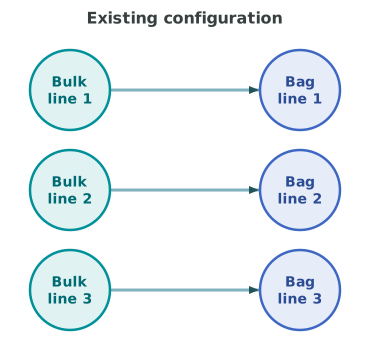
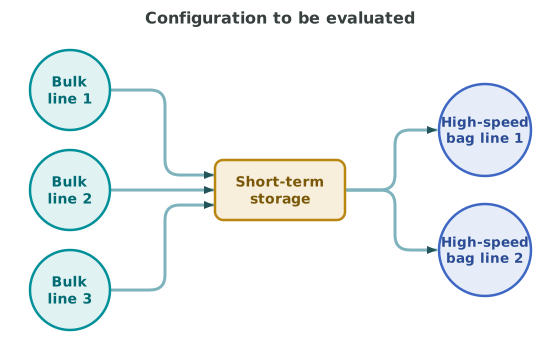
In a chemical packaging study, bag lines were tied one to one to bulk production lines and had to pack product off as it was made. The configuration being tested put short-term storage between the two, feeding new high-speed bag lines on their own schedule. The model weighed each configuration against the overtime it would need, and the client's analyst said it uncovered "additional options for low capital cost business growth, some of which were not readily apparent beforehand." Read the chemical packaging case.
The same lesson came from a consumer products plant where material was reblended back into the process. Storage needs changed with the schedule, and some problems that looked like they needed more tanks could be solved with scheduling parameters instead. The model was adapted at a dozen similar factories. Read the reblend storage case.
Signs your bottleneck moves
- Schedules that look feasible in the planning system keep slipping in practice.
- In-process storage runs empty on some products and backs up on others.
- Different people name different machines as "the bottleneck," and they are all right some of the time.
- A capacity project fixed the slowest step, and output barely changed.
- A process change, a new package size or a new product is coming, and nobody is sure the current scheduling rules will still work.
Why this needs a model that runs through time
A moving bottleneck is a timing problem. Which step limits output depends on what is running, what ran before it, how full the storage is and which machine just stopped. Static math averages all of that away. A simulation has to march forward through time and deal with each event as it happens, so it cannot fudge the specification. Building the model forces questions like "what happens when this machine runs out of supplies or breaks?"
That is what lets you ask "what would happen if we changed the package mix?" or "what would happen if we scheduled packing first?" and see the answer before you change the plant. An olive processor did exactly that: the model confirmed its suspected bottlenecks and showed that scheduling based on the Theory of Constraints could lift throughput 15%. Read the olive case.
We do this work in production line simulation and packaging line simulation projects, in ExtendSim, Plant Simulation or the tool your team already uses.
Tell us your problem
Does your bottleneck move?
Tell us what changes on your line: package sizes, mix or a new process step. We'll tell you what a model could show before the change goes live.
- A straight answer on whether simulation is the right tool
- Which tool fits, even if it isn't one we use every day
- A rough scope and timeline, before any commitment